






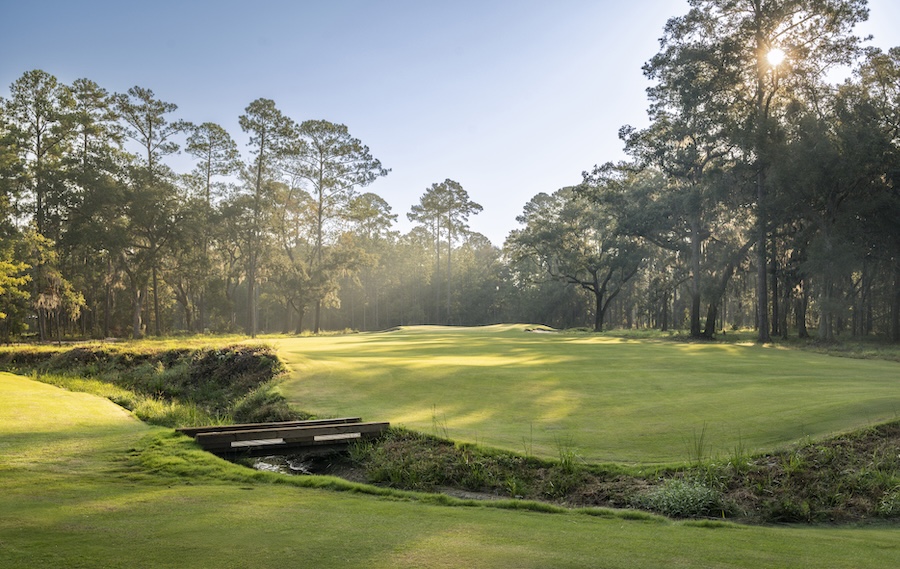
Latest design by one of the sport’s most revered architectural teams continues expansion of high-profile golf offerings at Lowcountry community
PALMETTO BLUFF, S.C. — South Street Partners, the team behind some of the most esteemed and thoughtfully developed private residential club and resort communities in the United States — including Kiawah Island, Palmetto Bluff, The Cliffs, Barnsley Resort, The Beckwith-Crested Butte, The King and Prince Beach & Golf Resort, PGA National Resort, Sawgrass Marriott Golf Resort and Spa, Naples Grande and Residences at Salamander — has announced the opening of Anson Point, the new 18-hole course designed by Bill Coore and Ben Crenshaw.
Named for Admiral George Anson, 1st Baron Anson, a famed British naval officer and explorer, the course embodies a spirit of exploration and timeless connection to place.


Known for their minimalist approach, favoring natural landforms and organic routing over dramatic alterations and artificial flourishes, Coore & Crenshaw’s philosophy of shaping the game around the land — rather than reshaping the land to fit the game — seamlessly aligns with Palmetto Bluff’s foundational mission led by the Palmetto Bluff Conservancy, a non-profit organization founded in 2003 to protect the land and wetlands throughout the community.
The site’s defining feature—a long-abandoned quarry first spotted by Coore decades ago when a previous ownership group had considered building a golf course, which never came to fruition—was rediscovered during course planning, now softened by time and nature. This revelation became symbolic of the course’s identity: a journey into the past, guided by land and legacy.

The course weaves through four distinct Lowcountry ecosystems — upland pine terrain, maritime forest, live oak groves, and expansive salt marshes framed by sabal palms. This variety gives each hole a different mood and rhythm, creating a course that feels alive and constantly inmotion, not built for spectators or showmanship but rather for those who see golf as a purposeful walk-through nature.
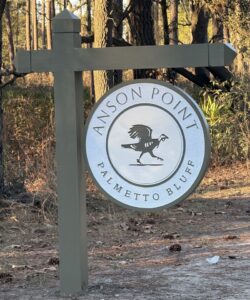
The course’s logo, an Eastern Wild Turkey, is a visual emblem of this ecological philosophy. Considered an “umbrella species” at Palmetto Bluff, the health of the wild turkey population is a key indicator of the broaderecosystem’s vitality. As the Conservancy often notes, “if the turkey thrives, everything thrives.”
The first phase of construction includes the golf course, temporary amenities including “The Roost” comfort station, and a maintenance facility.
A second phase will follow, consisting of a dedicated practice facility with over three acres of short-game areas, a clubhouse, andadditional communal spaces. Anson Point is available exclusively to Palmetto Bluff Golf Club Members and their guests.
Since assuming ownership of the property in 2021, South Street has worked closely with the Conservancy to upgrade and expand the community’s amenities to reflect an authentic sense of place, while addressing the shifting priorities of luxury homebuyers. Guided by their founding principle of “Designing with Nature,” an approach to development thatprioritizes conservation while enhancing stakeholder value, South Street continues to pursue a balance of environmental beauty with human activity.
Renowned for designs that showcase regional elements, Coore & Crenshaw were the natural choice for the conservation-minded firm’s new course.
Anson Point marks the next great chapter in Palmetto Bluff’s golf story. The new course’s layout was designed to offer a strikingly different experience from May River Golf Course, the community’s existing Jack Nicklaus Signature 18-hole course. Where May River offers bold visuals and elevated shotmaking, Anson Point leans into subtlety, texture, and restraint.
Together with Crossroads, the reversible nine-hole course from acclaimed golf architecture firm King-Collins Golf Course Design, each experience offers distinct yet complementary perspectives on what golf in the Lowcountry can be.
“As we studied the site that would become Anson Point, we came to believe it had the potential to yield a golf course of strong individual character, one that would provide highly interesting golf while showcasing the natural beauty of the Carolina Lowcountry,” said Bill Coore, designer and co-founder, Coore & Crenshaw. “Now upon completion, we think those goals have, or will be, attained.


“We were given a special piece of land to work with at Palmetto Bluff and feel that the Anson Point course nicely complements one of the most beautiful and historic communities in the South. We hope with this new course that we have created a memorable experience that golfers will find both enjoyable and challenging,” said Ben Crenshaw, designer and co-founder, Coore & Crenshaw.
Located on Palmetto Bluff’s East end, anchoring what will eventually be the community’s third village, Anson, the new course embraces a different approach to golf. Unlike most Lowcountry courses, which are laid out with residential real estate in mind, South Street requested the Coore & Crenshaw team make their decisions without a land planning model dictating the course’s evolution.
The absence of a residential component enabled the team to design a pure golf landscape for a pure golfing experience, preserving vital wildlife corridors and native ecosystems. Due to the lack of homes on the course, Anson Village will have a powerful sense of arrival and will eventually offer new amenities, neighborhoods, and gathering spaces.
“Bill Coore and Ben Crenshaw have designed some of the most extraordinary golf courses around the world, so they were theobvious first choice for our new course at Palmetto Bluff,” said Chris Randolph, Managing Partner, South Street Partners. “Our visions were aligned from the start – to create a masterpiece that would not only beexciting to play but would also fit within its setting as though it could have been built a hundred years ago.”
Anson Point’s holes were designed to fit the land’s natural contour, with each bunker mound and green complex reflecting the site’s existing features. The incredible variety of landscapes encompassed by the course is what makes it truly unique, and Coore & Crenshaw made a point to highlight these natural transitions.
Like their restoration of Pinehurst No. 2, rather than drawing a hard line between play and wilderness, the design uses native grasses, sandy edges, and unmanicured buffers to blend golf into the landscape. That subtlety adds a sense of timelessness from the very beginning, as if the course has always been there.
Although the course presents a thoughtful challenge to experienced players, it will remain approachable to golfers of all skill levels. Multiple tee boxes allow for flexible distances, and the routing encourages clever, strategic play over brute force. The greens are slightly smaller than average, with natural slopes and slight undulations reward accuracy and imagination.
Coore & Crenshaw kept the bunkering minimal but intentional (using native sand found on site), and instead of scattering sand across the property, they focused on strategic placement. Hazards are designed to make players think carefully about their approach without overwhelming the course’s flow or beauty. The result is a layout that feels fair but never simple, encouraging repeat play and rewarding those who learn its secrets over time.


