


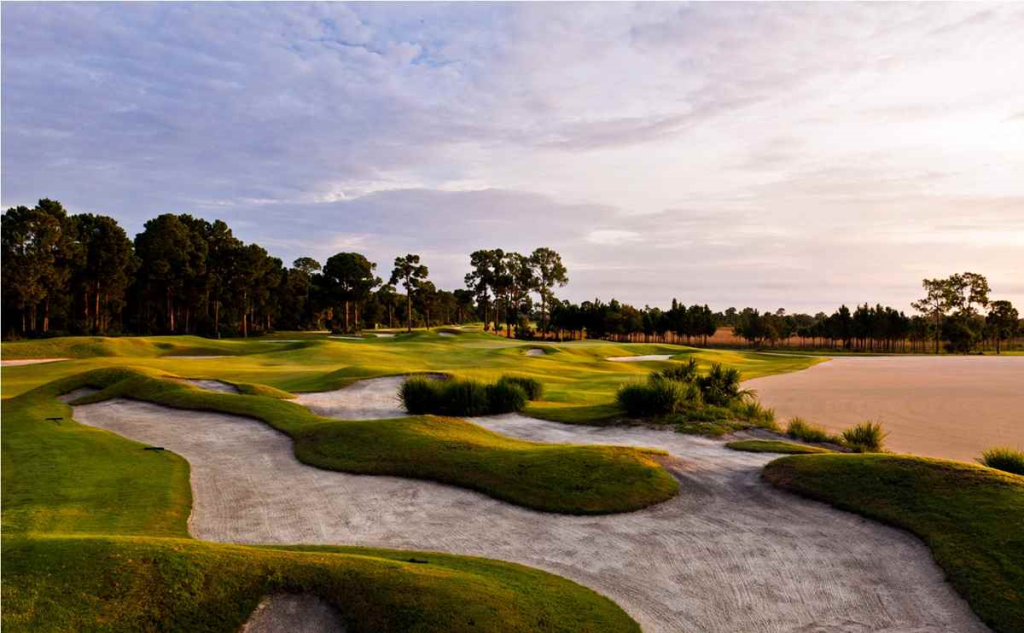
Hall of Fame designer wants golfers to relish playing this golf course and reward good play with good scores
PORT ST. LUCIE, Fla (March 20, 2019) – While Florida has nearly 1,300 golf courses that stretch from Pensacola in the far west to Key West in the far south, a must-play Florida golf destination is the PGA Golf Club at the PGA Village in Port St. Lucie.
Owned and operated by the PGA of America, the PGA Golf Club, ranked as one of America’s top 75 golf resorts by Golf Digest, has four golf courses open to the public.
“Very few golf destinations in the world are the home of four championship golf courses,” says Adriana Vizcaya, director of marketing, PGA Golf Club. “In essence, the PGA Golf Club is one-stop ‘shopping’ for golfers.”
The three on-site courses are the Dye, Wanamaker, and the Ryder. The fourth course – which has been renovated, revamped, redesigned, and renamed – is the St. Lucie Trail Golf Club.
The focus of this story is on the Dye Course, designed by legendary golf course architect Pete Dye. As you would expect, the Dye Course will deliver many memory making moments, from the opening drive to your journey up the 18th fairway. With five tees to choose from, this course ranges from 4,991 yards (Forward) to 7,221 yards (Medal).
“Golfers can love the Dye and they can hate the Dye on the same hole,” says longtime golf course superintendent Dick Gray, a protégé of Pete Dye. “The kid in you loves the challenge of the Dye and the adult fears the consequence. With the risky shot angles, bumps, hollows and slick and subtle greens, the Dye becomes a chemistry test.”
This Dye design, built in 2000, may not be as famous (yet) as some of his other creations, but this may be one of his most prized designs. The course is a pleasure to play, but is not a pushover. While water hazards are a common sight at the Dye, it’s easy to navigate around them.
Dye’s use of waste bunkers was strategic, as they serve as a sentries, guarding against errant shots rolling into the water or the vegetation that surrounds the course. The waste bunkers actually help maintain pace of play. Dye wants golfers to relish playing this golf course and reward good play with good scores.
During the summer and fall of 2016, the Dye Course underwent a complete renovation to its fairways and greens. The project was supervised by Gray. The fairways were converted to Celebration Bermuda while the greens are now TiffEagle Bermuda. The course is now as good as it gets.
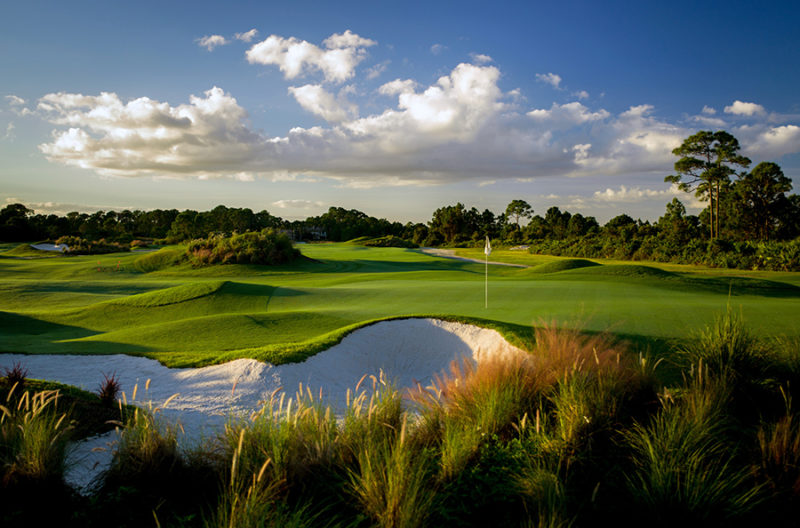
The first six holes – three par 4s, two par 3s, and one par 5 – are a microcosm of the Dye Course. Of the par 4s, one of them (the 2nd) plays like a par 5; one of them (the 4th) looks deceptively long, but isn’t; and the remaining one (the 1st) is rather lamb-like, as long as you avoid the fairway bunkers with your tee shot and greenside bunkers with your approach.
As for the two par 3s (the third and the sixth), both have trouble on the left. As for the par 5 (the fifth), it measures less than 500 yards from the Tournament tees, but the hole’s shape makes it rather difficult to reach in two. Since the green is fairly flat and not too big, reaching the green in three shots will leave you with a makeable birdie putt.
After experiencing the joy of diversity on the first six holes at the Dye Course, you’ll know what to expect on the remaining dozen. For the most part, the fairways are easy to find off the tee, the greens are fair and true, the 20 waste bunkers are easy to escape from, and the 147 bunkers are legitimate hazards. As for the water hazards, they are unforgiving.
It is clear that The PGA Golf Club is 100 percent focused on the game of golf, your enjoyment of the game of golf, and Mother Nature, as the course is a Certified Signature Sanctuary for Audubon International. Birdies, bees, and you are welcome at the PGA Golf Club.