





This figure, termed “latent demand” by NGF researchers, encompasses more than 21 million Americans. In consumer surveys, they indicate the highest level of interest in playing golf on a traditional course – this includes those who have never played the game before and those who want to return after more than a year away.
Mind you, this interest comes as the number of on-course golfers has jumped by 20% over the past six years, to its highest level (29.1M) in almost two decades.
Overall golf participation – on and off course – has risen more than 40% since 2019 (the pre-Covid comp). And there are even more non-golfers (over 28 million) who say they’re “very interested” in giving golf entertainment or simulator golf a try.
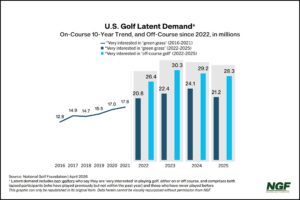

Case in point: the average annual “inflow” — people picking up golf for the first time or returning to the game — was about 30% higher from 2020 to 2025 than from 2014 to 2019.
Off-course forms of golf continue to widen the overall participation funnel, providing more casual formats and less intimidating introductions to the game. This can even extend to the increasing number of non-traditional formats that aren’t included in the off-course participation measure. The lesson… golf is about fun, people!
That matters because for many non-golfers, especially those who have never played, challenging perceptions persist.
Only about 36% of non-golfers say they’d feel comfortable around other golfers, and fewer believe they’d fit naturally into the sport’s culture. About half question whether they would feel welcomed at a golf course, underscoring the importance of not only inclusive green grass environments, but other avenues to ease into the game.
While maintaining high levels of attraction is important, converting that interest into sustainable participation is critical for the game’s future.
Today, only about one in four beginners become a committed golfer, the segment that drives the vast majority of rounds and spending. With millions entering the game each year, even incremental gains in retention could have an outsized impact.
Future-proofing the strength of our business depends on how effectively the industry can translate curiosity into connection, and ultimately that connection into long-term engagement.