





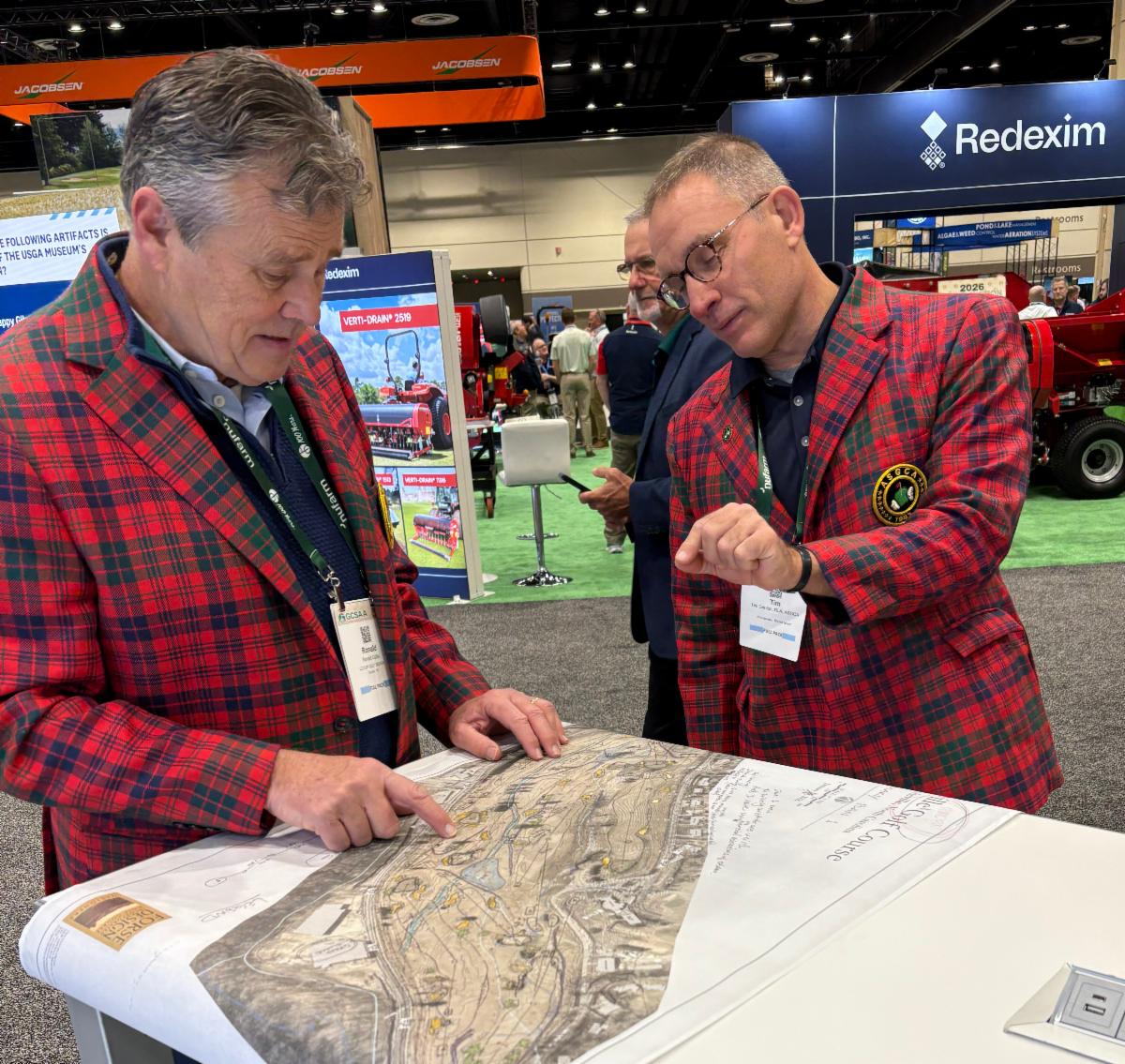
PROVIDENCE, R.I. — Tim Gerrish will mark 2026, his first full year as an ASGCA member, in fitting fashion. The Rhode Island-based course and landscape architect is busy with no less than 14 projects in various stages of development and construction, ranging from 18-hole bunker renovations, to new short-game areas, to clubhouse refreshments, to five new holes made possible by a clever land swap.
This spring, Gerrish will continue his methodical refreshment and refurbishment of two Donald Ross originals in southern New England: at Triggs Memorial GC here in Providence and Shenneccossett GC in Groton, Conn. In the Cape Cod community of Yarmouth, he will fine-tune the effluent re-use program at 27-hole Bayberry Hills GC, where he’s already expanded fairways, enhanced drainage and refurbished the bunkers.


The summer and fall of 2026 will prove even more lively, with new phases to manage at Pakachoag GC in Auburn, Mass.; at two Rhode Island private clubs (Valley CC in Warwick and Quidnessett CC in North Kingstown) at Windham (Conn.) GC, Sassamon Trace in Natick, Mass., and nearby Braintree CC; at Fenwick GC in Old Saybrook, Conn., and the private Silvermine GC down the road in Norwalk.
“The back half of 2025 was equally insane, running around New England trying to get things done before the snow arrived,” says Gerrish, who also rebranded his firm’s web presence over the winter (https://gerrishgolf-landscapearchitecture.com/).
“But it’s gratifying to be in demand, and membership in the American Society of Golf Course Architects has been a professional goal for two decades.
“I’m excited to be the first-ever member from Maine, and the first to wear the Ross-tartan jacket under new ASGCA President Mark Mungeam, a mentor of mine who, like me, is a champion of public golf.”
Gerrish’s extensive renovation work at Bayberry Hills has already proved a model for municipal facilities across New England. The 1991 design re-opened its final 9-hole installment last summer, following a series of upgrades at Gerrish’s direction, including major fairway modifications and bunker reconstruction that deploys Capillary Concrete liners.
The architect and N.J.-based Turco Construction also eliminated a handful of bunkers and repositioned several more “to freshen and sharpen up strategy.” They built forward tees serving six holes and applied the slit-drainage treatment to seven fairways that sit atop a former landfill.
“Little-appreciated fact: As landfill courses proliferate and age, it’s more and more clear how poorly traditional drainage measures move water through the soil profile above them,” explains Gerrish, whose 1999 master’s thesis (in Landscape Architecture, from the University of Massachusetts) centered on landfill course design. “This was something we theorized about when I did my graduate thesis.
“When I designed Sassamon Trace” — a 2001 landfill project in Natick, Mass., with Cornish, Silva & Mungeam — “we made certain allowances for that possibility. Today, seven holes at Bayberry play across a former landfill property. We know they need help and slit drainage is a pretty great solution because we can apply it with surgical precision, at a fraction of traditional drainage cost.”
The 27 holes at Bayberry are also the only ones in New England that utilize sewage effluent for irrigation: “That’s another area the where the club, its agronomic team and I are learning and responding to emerging conditions and data. All the time. For example, we’re working to move more effluent through subsurface disposal paths, which has created an increased need for irrigation storage.
“That’s an investment, but pond capacity also enables more maintained turf areas. It all fits together: With that capacity, we will expand the practice facility — we’ve already created wider hole corridors and more alternate routes of play out there.”
Gerrish, who hails from Lisbon Center in The Great State of Maine, received his B.S. in Horticulture from the University of Maine in 1991. While at UMass, he worked as an apprentice to ASGCA Fellow Geoffrey Cornish.
In 2000, he joined the firm of Cornish, Silva & Mungeam, where his design work would include Sassamon, the award-winning Butter Brook GC in Westford, Mass., Silva’s Seth Raynor homage at Black Creek Club in Chattanooga, Tenn., Black Rock Country Club in Hingham, Mass., and Mungeam’s 2003 U.S. Open ‘prenovation’ at Olympia Fields in Chicago.
In 2007, he founded his own firm, in Providence — just in time for a recession that did a number on course design practices across the country.
“Some lessons have proved particularly hard-won,” Gerrish says. “If nothing else, the 2010s taught us that all golf courses, but especially public courses, must be designed and redesigned with sustainability as a primary goal. Not just reducing the amount of maintained turf but systematically lowering ongoing maintenance requirements and labor costs across the board.
“It’s not all about cost efficiencies, though. Growing up in New England and working most of my career here means bigtime exposure to the work of Donald Ross, Wayne Stiles and Orrin Smith, to say nothing of Geoffrey Cornish, Brian Silva and Mark Mungeam. It’s a legitimate thrill, today, to put back into practice all that I’ve learned from them — at Ross designs like Shennecossett and Triggs — in combination with these modern realities.
“At Bayberry and Pakachoag, the Capillary liners mean we have drastically reduced sand-maintenance requirements while, at the same time, allowing more extensive sand flash in the cape-and-bay bunker style. The new forward tees don’t just drop overall yardage; they better align the golf hole for female players. At Bayberry’s 4th hole on the Links nine — where we re-graded a blind landing area to be visible, and more receptive to golf balls — we took an objectively bad hole and made one of the better par-4s on the course.”