


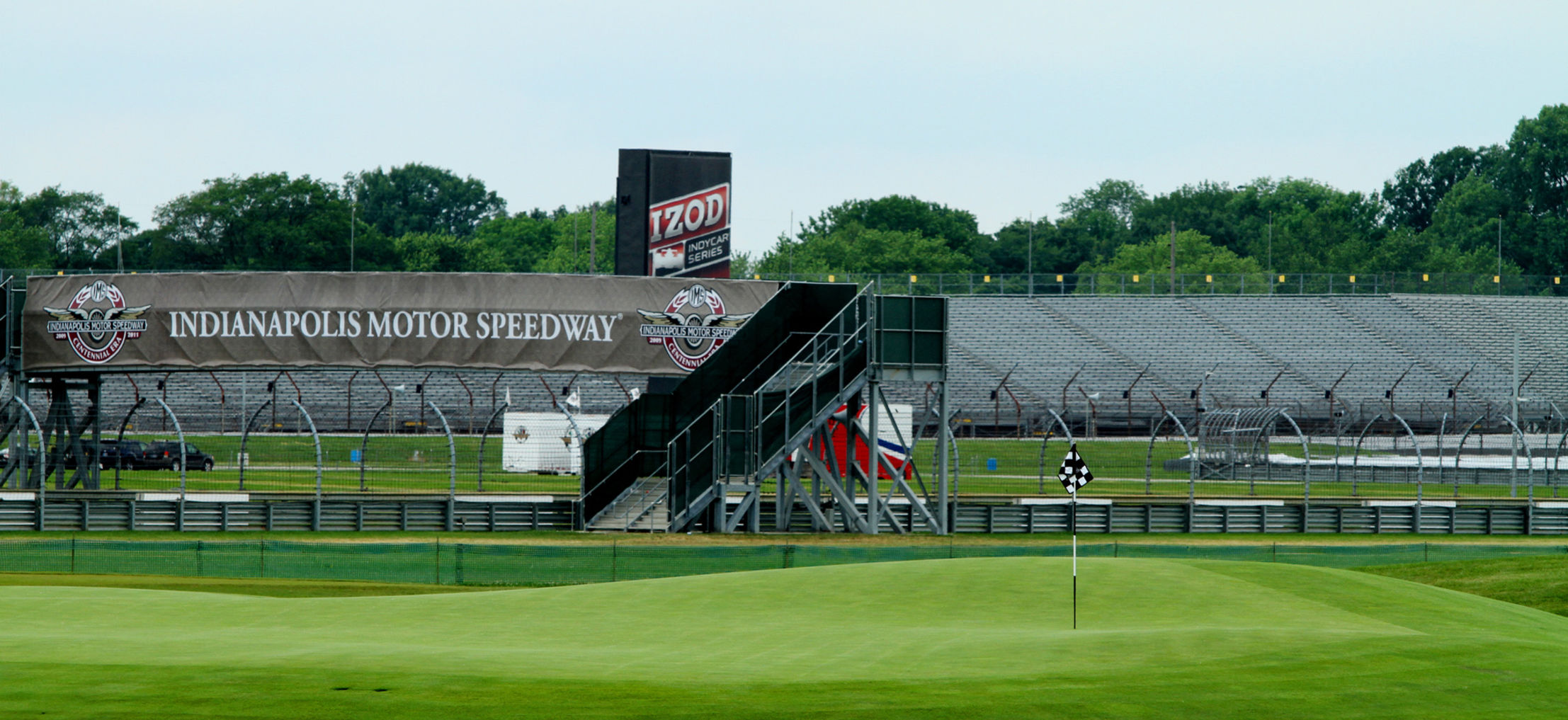
Golfers get the thrill of playing four holes inside venerable Indianapolis Motor Speedway
SPEEDWAY, Ind. (May 14, 2018) – In less than a fortnight, as upwards of 290 million households around the world watch the television coverage of the Indianapolis 500 – the biggest sporting event on the planet – most of the focus will be on the race cars whipping around the 2.5-mile track at speeds exceeding 230 miles per hour.
Expect golfers to pay a little more attention to the overhead shots of the action, especially those who have played the unique and ultra-challenging Brickyard Crossing Golf Course that borders- and even enters – the Indianapolis Motor Speedway along the massive edifice’s backstretch.
Because four of Brickyard Crossing’s 18 holes are set within the infield of the huge oval, the course is surely distinctive for its setting. But, thanks to the handiwork of native Indianan and famed designer Pete Dye, there’s a whole lot more to like about Brickyard Crossing than its location. This is one of the testiest golf courses in America, one that demands your best, especially on its home stretch.
Brickyard Crossing has a history almost as storied as the Speedway itself. Bill Diddel designed the original course on the site in 1929, when green fees for the 27-hole layout were 75 cents on weekdays and a whopping $1 weekends. Golfers crossed a wooden bridge over the brick-paved speedway to play nine of the holes in the infield on what was considered the first automobile racetrack golf course in the nation.
Each May in the run-up to the big race, car drivers and other celebrities played the course (then called Speedway Golf Course) alongside the pros in a PGA Tour event, the 500 Festival Open Invitation. Eventually, more of the infield was needed for the track’s infrastructure so, in 1991, Dye was hired to oversee the remodel.
The project took two years. It involved demolishing the old course and changing it from 27 holes (18 outside, nine in the infield) to the current 18-hole Brickyard Crossing, a nod to the racetrack’s nickname. A Champions Tour event, the Brickyard Crossing Championship, was played here from 1994-99.
Now one of seven courses on the Pete Dye Golf Trail, Brickyard Crossing allows golfers a vantage point most players never even considered – a round in the shadow of, and within, one of the world’s greatest sporting venues, one that attracts 300,000 fans every Memorial Day for the Indy 500.
Brickyard Crossing plays to a par of 72 and 7,180 yards from its back set of four tees. The tips carry a rating of 74.0 and Slope of 143, difficulty created by gently rolling terrain, a creek that enters play on eight holes and a handful of forced carries.
During the two years of construction Speedway officials replaced the track’s internal safety barrier, a concrete and rebar wall about four feet high, two feet thick and 2½ miles long. Faced with the prospect of crushing that material and carting it away at considerable expense, officials wondered if Dye could use any of it for the golf course. After studying a section of the wall that had been jack-hammered Dye asked about its weight and promptly announced, “I’ll take it all.” That original safety barrier was used to line both sides of the creek that runs throughout the 14 holes outside the Speedway.
Dye also placed a lot of the characteristics here for which he is known: waste bunkers and railroad ties; steep drop-offs behind putting surfaces; and an abundance of tall native grasses off fairways in which to lose a ball or two, and even an occasional stand of trees.
More than 1.5 million cubic yards of earth were sculpted to provide the dramatic terrain for Brickyard Crossing. For the most part, there are ample landing areas off tees, but golfers must be able to work the ball in both directions and be spot-on to find these demanding greens.
The first few holes are pretty straightforward – open fairways that are fairly level, with the creek providing some character. The layout then enters into some rolling terrain with surprising elevation changes. Along the way Dye spiced the routing with both pot and conventional-style bunkers; these hazards are quite tame early on but become more complex as the round progresses.
The most talked-about section of the course is the sequence of holes seven through 10 in the infield. From the sixth green, golfers move through a tunnel that goes under the racing surface to the interior of the racetrack. From the elevated tee on the 181-yard par-3, Redan-style seventh, golfers can see the track clearly and watch – or hear – as drivers get ready for the big race; practice laps take place year-round.
The 464-yard par-4 eighth is likely the toughest hole at Brickyard Crossing, with water running along the entire left side. The green is guarded by two bunkers at the right, making length and precision paramount.
No. 9, a 383-yard par-4, is peppered with 20 small bunkers, creating plenty of consternation as it moves right, then left, before ending at an elevated green. The 353-yard 10th asks golfers playing from the tips or second-longest tees to hit over one of the racetrack’s service roads to a fairway with a huge waste bunker on its port side that runs the entire length of the hole.
Once back outside the track, the grandstand for Turn 3 looms over the 11th, 12th and 13th holes, a 462-yard par-4, 581-yard par-5 (the longest three-shot hole on the course) and 193-yard par-3, respectively.
Brickyard Crossing then moves away from the Speedway and into another testy stretch. It’s here where the course has the majority of its real elevation changes. The 551-yard par-5 15th requires shots over the creek on the drive and lay-up, with the water a constant presence on the left all the way to the putting surface. No 16, a 465-yard two-shotter, also plays across the creek and has the threat of water through the green.
The 206-yard 17th is both the longest par-3 on the course and the most difficult, with a green above the creek bank (it’s an all-or-nothing carry) and four bunkers narrowing the focus.
After running that gauntlet, the 491-yard par-4 closer offers one final body blow, playing across the creek to the fairway and then back up to a green that may be the wildest on the course. Behind the putting surface is a barn that predates Brickyard Crossing, the original course and the Speedway itself, and was once part of the dairy farm that occupied the property before car racing – or a Pete Dye-designed golf course – became part of its history.
Brickyard Crossing has been voted as one of America’s Top 100 Public Golf Courses by both Golf Digest and Golfweek magazines and is one of a few courses in the country to host LPGA, PGA and Champions tour events.
The course now hosts the Indy Women in Technology Championship in the LPGA each August. For the tournament, the order of holes is changed so that the golfers complete their rounds on the four holes inside the Speedway.
Golfers might be first attracted to Brickyard Crossing because of its setting. But most leave thinking just how tough the round was and how they would love to get another chance to prove themselves. That sounds a lot like the sentiment most race-car drivers carry while trying to win the Indy 500, making the course a fitting companion to the vaunted Speedway.
