



Courses in I-35 corridor between Austin and San Antonio are worth pulling over for
Editor’s note: This is part one of a two-part series on fabulous golf in small towns in the Lone Star State
Great golf is where you find it, but discovering wonderful courses in the lesser-known places is much easier than you might expect. Smaller cities and towns in the state understand that golf courses, especially ones that offer excellent routing and conditions in locales off the beaten path, can be real economic engines and a true source of pride for their communities.
It seems like the Lone Star State has a plethora of such courses, in virtually every part of the massive state. From San Angelo to Texas City, from Lajitas to Gladewater, from Brownwood to Blanco, there are bigtime golf memories waiting in small towns.
Here are a handful of destinations that you should consider for golf away from the big cities. And we aren’t done yet…
New Braunfels
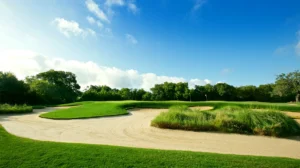
A template for great courses and golf experiences in a smaller town are the two offerings in New Braunfels, which sits about a half-hour north of San Antonio on the banks of the cool blue rapids of the Comal River.
New Braunfels was settled by Germans and the influences run deep in the town, which hosts the famous Wurstfest each November. The town is also the home of the original Schlitterbahn Water Park, part of which can be seen from just about anywhere in the area.
The golf courses here – Landa Park Golf Course at Comal Springs downtown and The Bandit Golf Club about 15 minutes east – are very different but equally fun.
Landa Park Golf Course, set in the famous park, was given a new lease on life by a complete renovation in 2013 by the noted Houston-based golf architecture firm of Finger, Dye, Spann. The designers were handed a $7 million budget to rejuvenate and refigure the course and, in the 13 years, since Landa Park GC has become one of the top places to play golf in the region.
No stone, green or bunker was left untouched in the renovation, and the layout that now winds through the park is fair but demanding, loaded with chances to score and penal enough to quickly get your attention if your game is not sharp.
Landa Park Golf Course is not long – it only plays at 6,205 from its back set of tee boxes. But the par 71 course can be a tester, with three of its par-3 holes carded a 182 yards or more, the tough 434-yard par 4 16th and the 571yard fourth hole, which from the tips is a true three-shot challenge.
Part of the experience at Landa Park Golf Course is watching the tubers tackle the rapids on the course’s edge; on the back nine, you’ll hear a lot of whooping and hollering at Schlitterbahn. There’s plenty of chances to get in touch with nature here as well – you’re likely to see ducks, egrets, and deer in its ponds and shady areas and grazing in the rough.

About 10 minutes east of town is The Bandit GC, the centerpiece of a neighborhood that still manages to be supremely isolated and fun. The track was sculpted into the rolling terrain along Long Creek and the shores of Lake McQueeney by world renowned golf course architect Keith Foster, who crafted a strategic and challenging 6,928-yard par-71 track with significant elevation changes and natural water hazards throughout. The course is a great balance of fun and challenge.

San Marcos
Sticking with the Central Texas theme, we travel another 20 minutes north up I-35 toward Austin and stop at Kissing Tree Golf Club in San Marcos, home of Texas State University and now, one of the most desirable 55-plus neighborhoods in the nation.
Opened in 2018 as an amenity of the burgeoning community, Kissing Tree was routed by Gary Stephenson and plays at an “easier for the senior set” 6,572 yards from the back tees. But there is nothing easy about the course – its set of four par 3s are among the most challenging you will ever play, and there are four par 4s that are carded at more than 400 yards (the 13th is carded at 449 yards!) and all seem to play into the wind.
Stephenson also designed reachable par 4s at the end of each nine – both are attacked downhill with the ninth at 325 into a cape green and the 18th just 287 yards.
Kissing Tree is very fair and challenging for all levels of play and is loaded with character throughout the course. The corridors off the tee are wide and forgiving, but not pushovers – this is really a second-shot golf course more because of the severity of the putting surfaces than the hazards around them.

The routing incorporates the natural rolling character of the land’s footprint and a Hill Country backdrop to create a memorable and testing experience for golfers.
The course at Kissing Tree serves as an extension of the natural landscape, blending grades on the edges, bringing the slopes and contours of the landscape into fairways. Each hole provides an avenue of play with varied angles that allow golfers of any skill level to enjoy the game and feel challenged.
Kissing Tree GC is part of the Audubon International program that preserves and highlights the native environment. With that in mind, Stephenson designed the course to be very gentle in shape, allowing it to fit seamlessly into the natural landscape.
A round here is memorable because of the variety, the conditioning and the way the whole package comes together over the course of play.