




It was founded in 1959 and golf has been played at the club since 1961, originally on a course designed by George Cobb. Arnold Palmer got the first commission to redesign some of the course and changed a handful of holes in 1986.
Fazio led a redesign in 1997 and has made modifications to the course four other times – in 2003, in 2013-14 when all the putting surfaces were rebuilt, in 2016 when he revamped the bunkers in advance of the 2017 PGA Championship and in 2023 when he moved some bunkers to add the need for length off the tee to an already long (7,521 yards) course.
The renovations have, in essence, modernized the course, almost hole by hole, over the years.
Quail Hollow, the home of the Truist Championship in years it’s not hosting a major championship, is a lovely, yet dangerous, parkland-style course that highlights the rolling terrain of the Piedmont region of North Carolina. It’s routed through stands of fairway-narrowing trees, with plenty of water and sand to enhance the challenge.
If you’ve played a Fazio-designed course, and you likely have if you are reading this feature, then you know the architect likes to go “big.” He’s not afraid to move a lot of dirt to get the course he sees in his head, and Quail Hollow is no different in that respect.

Fazio gives golfers wide landing areas to reward bold play and long hitters; his greens are huge – sometimes the player feels that there is enough room on the putting surfaces for two greens – but they are segmented, and hole locations are demanding to accentuate the need for dead-on approach shots.
Quail Hollow is famous for its closing stretch, Nos. 16-18, that is collectively known as “The Green Mile.” Consisting of a 506-yard par-4, followed by the 190-yard par-3 surrounded by water and the 494-yard closing hole, the daunting trio usually has a lot to say about who wins the championship.
Quail Hollow’s back-nine is much tougher than the front, as a 14-acre lake comes into play on many of the holes. Expect the putting surfaces, turfed with Champion Bermudagrass, to be firm and fast. The course as a whole is very strategic and well-bunkered off the tee and sets up for players to visually read each hole and see the shots that have to be hit.
Fazio made sure that Quail Hollow’s routing is very playable for the membership that tees it up on the course the other 11 months of the year.
“When we were in the planning process we were always thinking about the best players in the world,” Fazio said in advance of the PGA Championship in 2017. “That can be a tendency to think hard, but that’s not the case. We’re not into just hard because we have a membership that plays this golf course.”

You have to be invited to become a member at Quail Hollow Club so just playing the course here is a rare treat for even the top players in the world.
The bottom line is that Fazio’s course brings out the best in the best.
Other options for golf in North Carolina
While you’ll have a tough time wrangling a round at Quail Hollow, there are plenty of great public access courses in North Carolina. Here are three options:
Linville Golf Club, Linville
Golden Age architect Donald Ross’s fingerprints are all over Linville Golf Club, located about two hours northwest of Charlotte and one of the oldest courses in North Carolina. He designed the course here in 1924, but by then folks had been playing golf on the site for more than 30 years.
The tagline for the course here is “the challenge is in its simplicity,” as Ross’s course rambles through tree-lined fairways to smallish greens. The par-4 third hole at Linville, on which a creek crosses the line of play three times, has been called one of the top 100 holes in the world by Golf Magazine. Complete the trip to the edge of the High Country with a stay at the Eseeola Lodge.
Rumbling Bald, Lake Lure
Set on the edge of Lake Lure about two hours west of Charlotte, Rumbling Bald is an idyllic 36-hole retreat featuring contrasting layouts by Dan Maples and W.B. Lewis. Rumbling Bald’s marquee course, the Maples-designed Apple Valley, stretches to almost 6,800 yards and features expansive views of Bald Mountain as mountain lakes adorn 12 holes.
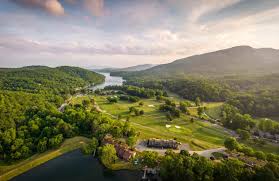
The Lewis-fashioned Bald Mountain course plays at 6,300 yards and is renowned for its unique configuration with five par 5s and five par 3s. Movie buffs appreciate the 16th green, the backdrop of a scene from the movie “Dirty Dancing.”
Grandover Resort Golf and Spa, Greensboro
This resort is set about two hours northeast of Charlotte and has two courses, the East and the West, designed by former U.S Open and PGA Championship winner David Graham and Gary Panks. The courses move up and down rolling fairways and through stands of oaks, pines and dogwoods among the property’s 1,500 acres. Fairness abounds, a hallmark of the underrated design team’s courses.