


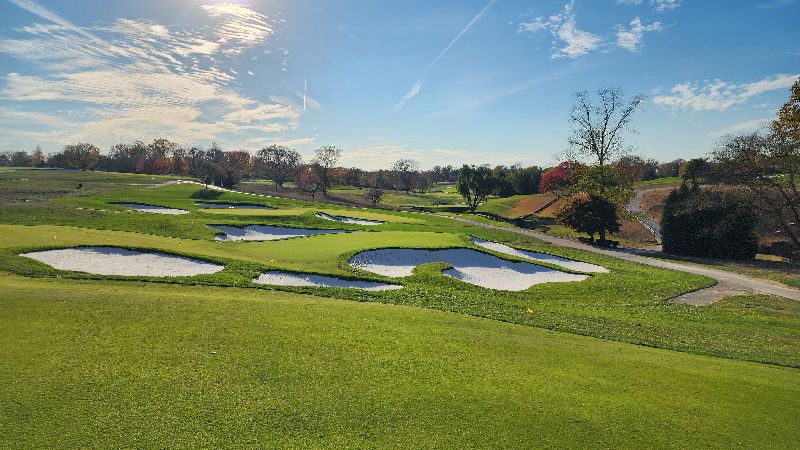
The Mill nine of Philadelphia Country Club has reopened after a project led by Jim Nagle. The completion of the Mill works means that all 27 holes of the club have now been renovated by Nagle.
Philadelphia CC was one of the first seven members of the USGA. The Spring Mill 18 was originally designed by William Flynn and opened in 1927; the brief for the Nagle rebuild was to recapture the course as it played for the 1939, before which Flynn consulted with the club with suggestions for added bunkers, new tees and even a recommendation to the USGA to play two par 5s as par 4s considering the advances in equipment and ‘the physical and mental aptitude of the players.
“I think it’s extremely significant that, 87 years ago, Flynn was advocating for change because of equipment and player improvements,” says Nagle.
 The third nine at Philly CC is the Centennial, designed by Tom Fazio and opened in 1991. Nagle renovated that nine during the Covid pandemic, removing two par 4s to accommodate a new driving range to supplement the existing range, which was judged too small and short; he rerouted the course to incorporate nine holes within the footprint of seven.
Nagle then moved on to the historic Spring Mill course. The front nine, called Spring, was rebuilt after August 2023, reopening on Memorial Day last year, while the back nine, Mill, closed that August, and has just reopened.
“By phasing the project like this, we ensured the members always had eighteen holes open for play,” says Nagle. “This is important in a club that has over 700 golfing members.”
Much of the Spring Mill project was driven by infrastructure improvements – rebuilding greens, tees and bunkers, a new irrigation system, regrassing of fairways and an extensive tree management program – but Nagle has used aerial and ground level photos taken at the time of the 1939 Open to restore Flynn’s design.
Most of the original bunkers have been restored. Seven holes had a bunker added, reinstated or relocated to account for today’s equipment and play – the same as happened in 1939.
 “I’m most proud of the thoroughness of the restoration process and the attempt to be as accurate as possible with the information available to us,” says Nagle. “We have used 3D laser scannings to restore the integrity of Flynn’s greens, blending or melding expanded areas and recapturing of lost hole locations and slopes.
“The property is brawny – big, broadly contoured and expansive, and matches the grandeur of the Flynn design’s. The course was previously shrouded in tree cover, but it has been revealed by the tree management program – though we have kept a large number of specimen trees, which can now be seen in all their glory.
“The only non-original golf hole on the property was the 18th, which was redesigned in 1955 to accommodate the relocation of the clubhouse. The present closing hole was originally the fifth. From its opening, the membership was never really pleased with the hole that was designed – so we redesigned it, drawing inspiration from Flynn’s design principles, including the sixteenth at Shinnecock Hills, and lengthened the hole from 392 yards to 450 yards, while creating a green complex that drew inspiration from the original fifth.”
The club is overjoyed with the work.
“Our Spring Mill restoration has achieved our loftiest expectations,” says James Black, a past president of Philadelphia CC, and the inaugural chair of its golf task force “We have maintained and enhanced the course’s premium on great shot-making and again have a course that tests every player and rewards only those who possess all the varied shots of golf.
“Our members and guests are now raving about the new vistas uncovered and the restored hole design that gives players of every length the variety and challenge that was first created so long ago. Our new green complexes allow for so many challenges that you can play our restored course again and again and always have a new challenge.
“Our restoration vision, a decade in planning and execution, was to have a great course for every golfer, of every level. We are beyond happy that the finished product is now being enjoyed and praised by everyone who experiences it.”
Nagle’s involvement with the club dates back to the early years of this century, when he and Ron Forse developed a masterplan for the property.
“Personally for me as an architect, this has been the most involved, challenging and rewarding project I have worked on in my career,” he says.
