


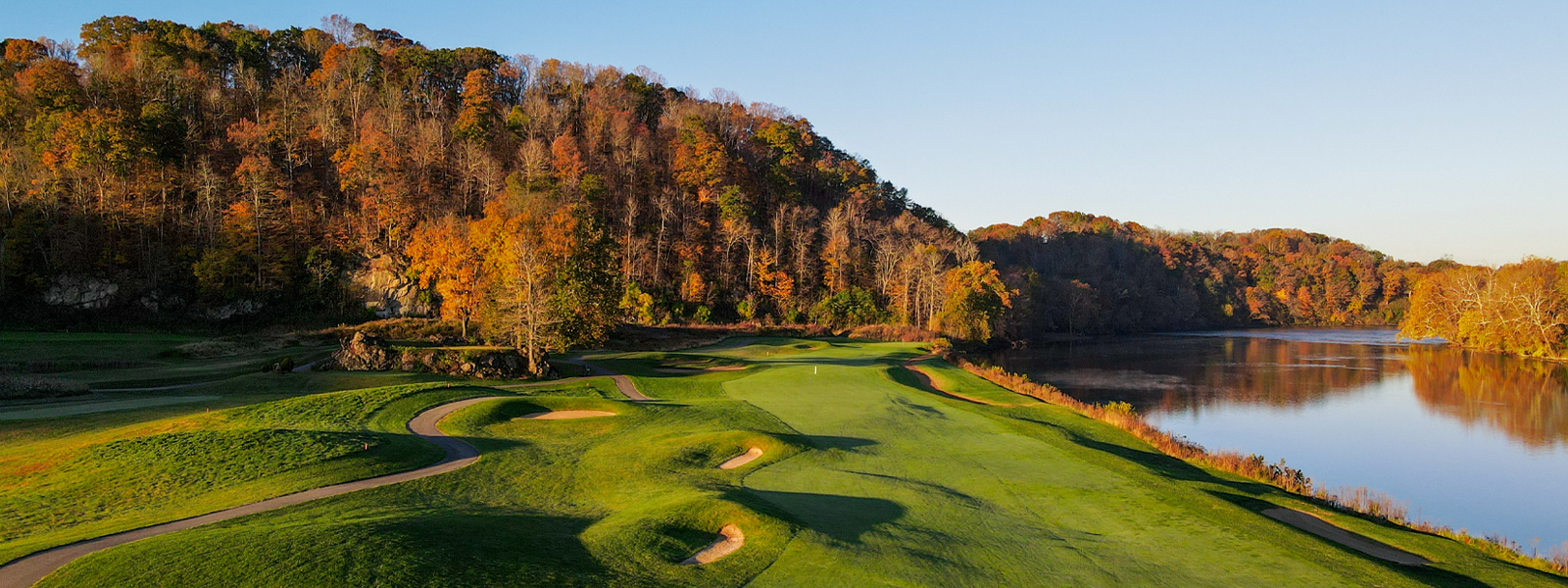
Dye’s creation — which supplanted a five-year-old layout fashioned by Brian Ault and Tom Clark — opened in 2005 and plays to 7,665 yards from the tips. The course occupies a nice piece of land with a backdrop of water, mountains and trees and offers players isolation and challenge.
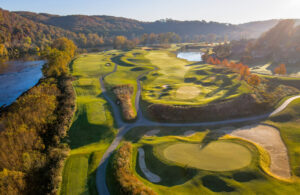
The renovation — Dye called it a “blow-it-up-and-start-over situation” — was championed by Bill Goodwin, a noted Virginia Tech supporter perhaps best known for developing Kiawah Island Resort in South Carolina (also a Dye design). Goodwin wanted VT to have a top-notch facility for the university’s golf teams and hoped to create a good enough course to host NCAA events.
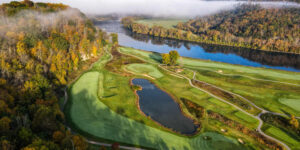
Dye built mounding between River Course’s holes, separating them from each other while creating an illusion of solitude despite the property’s compactness. He also reduced the size of the putting surfaces and surrounded them with areas where wayward shots will collect, requiring the player to have excellent short-game skills if missing the greens.
The combination of distance and direction, set among these primitive rock faces, Dye-trademark pot bunkers and the nearby gently rolling river present a thorough golf experience.
The putting surfaces at River Course are small and kidney-shaped and become very narrow at the back, giving the course flexibility in its setup. If the pins are set in the front, players can run the ball up, and it’ll play much easier for average players and women. It’s a course that can be friendly, and at the same time, can be very tough.
And the River Course’s greens are relatively flat. Dye understood that designers can no longer “bury elephants” in the greens when you’re trying to get the speeds up to 11 and 12 on the Stimpmeter.
So the real challenge at the River Course comes from the fairway, as getting your approach close to the day’s hole location is essential. There’s only one forced carry over a bunker, and that’s on the par 3 seventh, which plays 159 yards from the back tee. Every other hole is open in front to promote run-up options.
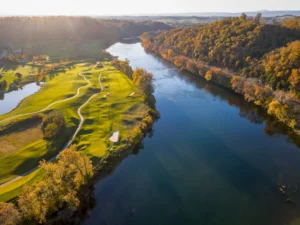
After tackling the massive 475-yard par-4 second, players get their first real look at the New River on No. 3, a 588-yard par 5 that typically plays into the wind. The entire port side of the hole is flanked by the river, and its final 200 yards are separated from the water by a deep and narrow bunker.
The 497-yard par-4 fourth also has character. It’s a dogleg-left with a pond in the bend to deal with on the approach. Nos. 8 and 9 head back to the river. The eighth is a slight dogleg-right, 426-yard par 4 that moves away from the New River to a demanding four-tiered green. No. 9 plays at 579 yards from the tips and requires great shots to avoid bunkers right of the fairway off the tee and to reach a thin green that has a slight swale through its midsection.
The 488-yard par-4 11th is bordered left on the approach by a large lake and its green slopes severely back to front. The River Course ends with the 243-yard par-3 17th and the 495-yard par-5 18th, two massive challenges on an already taxing track. No. 17 has a deep bunker along its entire right side and the river sweeps by on the other side of the sand, forcing any miss to be to the left. There’s even a pot bunker if you miss short and right.
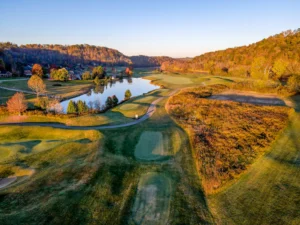
The closer is another Dye classic — narrow off the tee to an undulating fairway that ends with a putting surface protected by three deep bunkers and angled toward the river on the right. At nearly 500 yards, many players will choose to take danger out of play and hit both their first and second shots left to stay dry, but the bold will play down the right to shorten the approach.
A real treat is playing the River Course in the late afternoon, in the hours before dusk, as its bumps and rolls and angles and edges come to life. Dye’s work here is best characterized by the way he let Mother Nature do the talking. She is, after all, the ultimate golf course designer.