


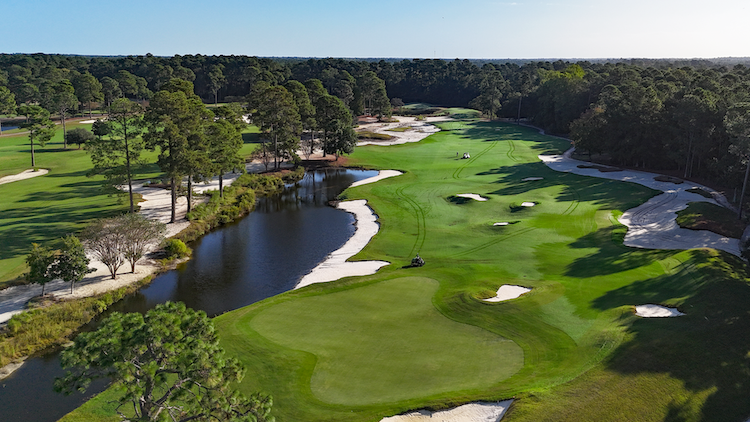
MYRTLE BEACH, S.C. — King’s North at Myrtle Beach National, one of Arnold Palmer’s most recognizable designs, has completed a sweeping, two-year renovation that redefined the playing experience.
Led by acclaimed architect Brandon Johnson, the project delivers a golf course that is bolder, more strategic, and more visually striking, positioning King’s North among the best public courses in South Carolina.
 Completed in two phases – front nine renovations in the summer of 2024 followed by the back nine in 2025 – the transformation went beyond cosmetic upgrades. Fairway corridors were restored, greens and surrounds were reimagined, and strategic intent was sharpened throughout the layout. The result is a course that feels familiar in spirit, while providing players a new experience.
“Golfers who have played King’s North before are going to be blown away by how different it plays,” said Johnson, who worked alongside Arnold Palmer for 17 years and now leads Brandon Johnson Golf Course Design. “This wasn’t about small tweaks. We leaned into bold ideas – restoring width, creating new angles, and building green complexes that reward creativity and thought. Every hole now asks a question.”
Free of residential development and routed for walkability, King’s North offers an experience that appeals to elite players while remaining fun and playable high handicappers.
The renovation also included selective vegetation removal to reveal long views across the property and better showcase the land’s natural movement. Greens were expanded and reshaped, surrounds were rebuilt to encourage ground play and recovery options, and hazards were repositioned to heighten both risk and reward. Collectively, the changes create a course that is more dramatic and strategically engaging from the first tee to the final putt.
“King’s North has always been special, but this renovation takes it to another level,” said Steve Mays, president of Founders Group International, Myrtle Beach National’s parent company. “The changes are big, bold, and intentional. We genuinely believe King’s North now belongs in the conversation with the best courses in Myrtle Beach and the state of South Carolina.”
Johnson noted that while some improvements are immediately obvious, others will reveal themselves over multiple rounds. “The course has greater depth now,” he said. “The more you play it, the more you will appreciate what’s there.”
The renovation respects Palmer’s original vision while presenting it through a modern lens, one that reflects how today’s golfers play, think, and experience the game.
“If Mr. Palmer were standing on the first tee today,” Johnson said, “I think he’d recognize the soul of the course and be proud of how far it’s been pushed.”
More broadly, the rebirth of King’s North reflects Founders Group International’s continued investment in excellence, ensuring its most iconic courses remain compelling and nationally respected.
Founders Group International owns 21 Myrtle Beach-area courses and has completed more than a dozen major renovation projects in recent years, including Grande Dunes, Pine Lakes, Pawleys Plantation, and TPC Myrtle Beach, with additional renovations planned across its portfolio.
 Golfers can now experience a fully reimagined King’s North, where bold visuals, strategic shot-making, imaginative greens, and classic Palmer-style risk-reward define a course that feels both timeless and entirely new.
For more information or to book a tee time, visit MyrtleBeachNational.com.
Hole by Hole: Your Guide to the New Front Nine at King’s North
The renovation of King’s North at Myrtle Beach National is complete. As you look forward to playing one of Myrtle Beach’s iconic layouts, we talked with architect Brandon Johnson about his overhaul of the Arnold Palmer classic. Based on the conversation with Brandon, here is a hole-by-hole guide to the “new” layout.
No. 1
Par: 5
502 yards
Handicap: 10
The opening hole remains a reachable par 5, but subtle design tweaks have transformed it into a more engaging start. Reoriented bunkers now define sightlines and strategy from tee to green, while the once-hidden bunker left of the putting surface provides new visual and strategic interest. A grove of trees guards the left side, rewarding drives favoring the center-right. Cross bunkers demand a choice: lay-up safely or challenge the line for a better angle into the newly contoured green.
No. 2
Par: 4
409 yards
Handicap: 8
This medium-length par 4 often enjoys the benefit of the prevailing wind. Two fairway bunkers frame the tee shot, and once safely in play, golfers face an approach over a yawning waste area guarding the front of the green. Johnson reshaped green-side mounds, converting what was once heavy rough into a new feeding slope on the left side, allowing players to feed balls toward tucked pins.
No. 3
Par: 4
365 yards
Handicap: 12
A risk-reward hole, No. 3 captures the heroic spirit of King’s North. The tee shot plays across a large pond, forcing players to choose between the safer right fairway or the more daring line over the waste bunker toward the green. The renovation refined the waste area and reimagined the green complex, adding new depth and variety. The elongated putting surface now features new pin positions and reshaped surrounds that invite creative recovery shots. Those who challenge the longer carry are rewarded with the best angle into this narrow green.
No. 4
Par: 3
180 yards
Handicap: 16
A short to mid-length par-3, No. 4 plays into low-lying cove where the wind tends to swirl, so take enough club to comfortably carry the water guarding the front. The newly enlarged green extended both left and right, introducing a wider range of pin placements and shot options. The left side features a subtle sideboard and backboard, allowing players to feed the ball toward the hole for a birdie or (dare I say) better.
No. 5
Par: 4
347 yards
Handicap: 14
Another short par 4, this dogleg left invites aggression, but that requires challenging the left tree line and fairway bunker to reap the primary benefit: a short pitch into a receptive green. The horseshoe-shaped putting surface is guarded by three bunkers that sit snugly across the front, effectively bisecting the approach. Accuracy is everything here; those who find the right angle off the tee can set up an excellent birdie opportunity.
No. 6
Par: 5
568 yards
Handicap: 2
After a few early risk-reward choices, “The Gambler” raises the stakes. This iconic par 5 offers two distinct routes: play it safely down the right side, avoiding water but adding distance, or take the gutsy line to the island fairway. The aggressive play cuts off significant yardage and sets up a great angle into the green, which features a generous backstop to help hold approaches. But true to its name, the hole demands nerve as water surrounds the island fairway and fronts the green, meaning one bad swing can turn dreams of birdie into a double bogey.
No. 7
Par: 4
423 yards
Handicap: 6
This is a short to mid-length par 4 that often plays into the prevailing breeze. A large waste bunker connects Holes 2 and 7, guarding the left side of the fairway and catching drives that are pulled offline. The fairway has been widened, giving players more room to navigate. The reshaped green now features intriguing front-right, back-right, and back-left pin positions, with a deep rear bunker on the right ready to catch wayward approaches.
No. 8
Par: 3
190 yards
Handicap: 18
The second par 3 on the front nine, No. 8 offers a wide range of tee and yardage options. One of the larger and more receptive greens on the course, it features a distinct middle tier and bowl-like back section. Aggressive players can use the sideboards and back slopes to access back pins, while those facing front locations can safely play beyond the flag and let the contours feed the ball back toward the hole.
No. 9
Par: 4
465 yards
Handicap: 4
The front nine finishes with a flourish as this two-shotter offers a generous fairway and a clear view framed by a new waste bunker that ties into Hole 10. This is a straightaway hole that offers a classic look and feel. The front of the green is open, allowing players to run the ball up, but the putting surface subtly falls away, making good club and shot selection of vital.
No. 10
Par: 5
517 yards
Handicap: 13
The renovation of No. 10 added visual drama and strategic intrigue. Off the tee, players are now greeted by a bold new look, as part of the cart path has been converted into a sprawling waste bunker, instantly heightening the hole’s aesthetic and challenge. Adjusted bunker alignments and an additional fairway bunker create more decision-making on the second shot, rewarding thoughtful play. Around the green, the right side has been lifted to block views of the adjacent ninth tee, better framing the approach. Contours feed into the green from the right.
No. 11
Par: 4
470 yards
Handicap: 11
The renovation of No. 11 embraces subtlety, creating a quiet but memorable moment on the back nine. Bunker work was the centerpiece of the renovation here, with the short-left cross hazard repositioned for greater visibility and influence. The right greenside bunker was also shifted to better engage the putting surface, guarding new pin positions on that side and demanding precision on approaches. Around the green, the artificial mounding was removed so the putting surface sits lower, framed naturally by gentle contours. With its understated slopes and nuanced breaks, No. 11 contrasts beautifully with the bold features of the 10th hole.
No. 12
Par: 3
140 yards
Handicap: 17
The iconic island green par-3, home to the famed “SC” bunker, has been refined to enhance both playability and visual appeal. The signature bunkers have been reshaped so that their sand lines are more striking from the tee, while also restoring their strategic relationship to the putting surface. The green itself has been expanded, offering a larger target and more variety in pin positions, while subtle contouring adds interest. The result is a hole that remains true to its heritage but is more fun to play
No. 13
Par: 4
407 yards
Handicap: 3
No. 13 saw some of the most significant changes in the renovation, beginning with a reimagined teeing area. The old bulkhead was removed, and the tee shifted to the right, softening the angle of the dogleg left while expanding teeing options. In the fairway, the two inside bunkers were eliminated in favor of a larger sandy waste area, giving players the freedom to choose their line over the trouble. Around the green, Johnson introduced punchbowl-inspired shaping, with containment slopes and feeding contours designed to funnel shots toward the surface. A prominent front-right bunker adds to the drama.
No. 14
Par: 4
433 yards
Handicap: 9
The renovation of No. 14 enhances the risk-reward decision every player must make. The existing waste bunker down the left side has been expanded and made more visible, daring players to challenge it for a better angle into the green. Those who bail right will find expanded fairway but also subtle contours that can shed the ball, along with trees that influence approach angles. The green itself has been reworked to add variety, with expansion in the front and left creating new hole locations. A reconfigured front-right bunker guards the surface, while a new back-right pin will be a toughie.
No. 15
Par: 5
567 yards
Handicap: 1
The par-5 15th differs from King’s North’s other three-shotters, climbing uphill on a slight dogleg left before playing to a tucked green. The long waste bunker down the left side is more visually prominent, adding to the challenge off the tee. Around the green, Johnson eliminated old containment mounds that didn’t impact playability and restored the putting surface to its original size. He then reworked the greenside contours to enhance both challenge and recovery. Subtle hollows and slopes around the green create variety; some spots are forgiving, while others test short-game skill. With its reimagined surrounds, strategic bunkering, and fun new pin positions, No. 15 is full of character.
No. 16
Par: 4
410 yards
Handicap: 7
This mid-length par 4 offers players an opportunity to score coming off holes 13, 14 and 15, the course’s toughest three-hole stretch. The straight-away hole encourages aggressive play off the tee. Fronted by water and a beach bunker that adds visual drama, No. 16 now features a small “thumbprint” bunker short of the green that breaks up the approach and protects a new middle pin location. A newly added back bunker also defends a back-right pin, replacing what was once just a mound and giving that position a more ominous feel.
No. 17
Par: 3
160 yards
Handicap: 15
With its natural sandy waste area, pond, and ornamental landscaping, No. 17 already had strong bones, but the green had shrunk considerably. Johnson expanded and reshaped the putting surface, reestablishing slopes and reconnecting the bunkers to the green complex. The result is a visually striking hole with distinct challenges depending on the pin. Left-side locations bring the beach bunker into play, creating a devilish test, while right-side pins allow players to use a slope as a backboard.
No. 18
Par: 4
464 yards
Handicap: 5
The closing hole at King’s North underwent one of the renovation’s most dramatic transformations. Once dotted with more than 40 small bunkers, most of which lacked visibility or strategic value, the hole now features a bold new look. The majority of bunkers were removed, replaced with a large, continuous waste area down the left side that ties into the course’s broader design. On the opposite side, dirt removal opened up clear views of the lake, adding beauty and risk. At the green, restored boundaries and radically reworked contours create variety, including a back-bowl pin on the left and expanded surface along the water on the right. With its striking visuals and flexible setup, No. 18 offers a memorable finish.